pvcollada
Representing an east-west PV array
An east-west PV array typically mounts rows of modules back-to-back to form a peak, with the two sides at the same tilt:
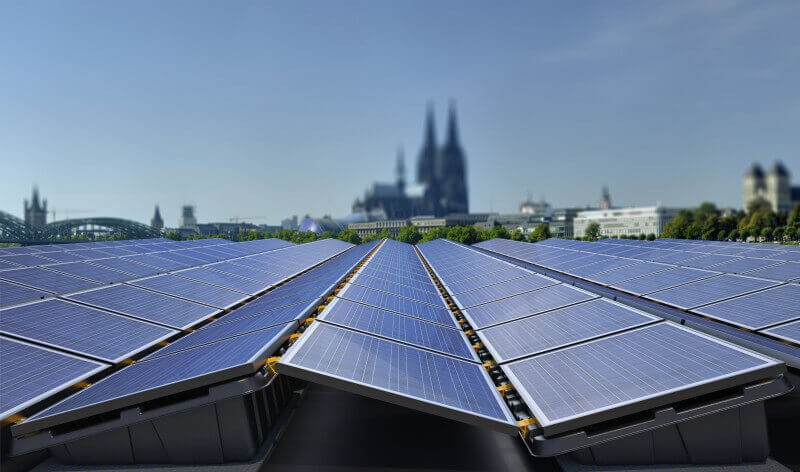 Image credit: GSES (2026)
In PVCollada, a rack is defined as as a co-planar group of modules. Thus, the east side of a row is one rack and the west side is a second rack.
In the COLLADA implementation, the shape of each side of an east-west rack can be defined with one instance of \<geometry\>, assuming both sides have the same dimensions.
Then, a \<node\> is created for each side of a row, with the <instance_geometry> property referencing the defined \<geometry\>. Separate \<node\> are needed so that the
each side has a unique \<id\>. Finally, the racks are placed in the visual scene by placing instance of \<node\> using \<translate\> and \<rotate\>.